
The Light That Almost No One Sees
The Person Who Taught Architecture How to Use Light
Think of a simple moment.
You walk into a restaurant and the atmosphere immediately feels comfortable.
In a museum, your gaze is naturally drawn to a specific artwork.
In a hotel, the space feels elegant, calm, almost cinematic.
Most people attribute this to architecture or design.
But very often there is another silent element doing this work.
Light.
Curiously, for much of architectural history, artificial lighting was treated merely as a technical necessity. It served to push back darkness and allow people to see what they were doing.
Nothing more.
There was little idea that light could create emotion, guide the eye, or completely change the way a space is perceived.
Until someone began looking at light in a different way.
The Moment Someone Realised the Power of Light
In the 1930s, a young American designer began asking a question that almost nobody seemed to be asking:
What if light could do much more than simply illuminate?
His name was Richard Kelly.
At the time, lighting was almost entirely in the hands of engineers. Discussions revolved around power, efficiency and illumination levels, but rarely about atmosphere or experience.
Kelly saw something different.
He saw light as a tool capable of revealing architecture, guiding people and transforming the way a space is experienced.
In 1935 he opened his own studio in New York and began collaborating with some of the most influential architects of modernism, such as Mies van der Rohe, Philip Johnson and Louis Kahn.
These collaborations placed him at the centre of some of the most iconic buildings of the twentieth century.
But the most important thing was not only the projects themselves.
It was the way he began to think about light.
The Simple Idea That Changed Everything
Richard Kelly realised something fundamental:
Not all light needs to do the same thing.
To explain this idea, he introduced three concepts that still form the basis of many lighting projects today.
Ambient luminescence
The general light that allows us to perceive a space as a whole and creates a comfortable visual foundation.
Focal glow
Light that highlights something specific — a work of art, a table, a staircase or an architectural element — naturally guiding attention.
Play of brilliants
Sparkles, reflections and points of brightness that introduce energy, dynamism and visual excitement into a space.
Today this idea may seem obvious.
But at the time, it was revolutionary.
Kelly was essentially saying that lighting should not be uniform and neutral. Light could play different roles within a space.
It could tell a story.
When Light Became Part of Architecture
These ideas became visible in some of the most influential buildings of modern architecture.
At the Seagram Building in New York, lighting helped reinforce the elegance and clarity of the architecture.
.png "Seagram Building")
At Philip Johnson’s Glass House, Kelly used artificial light to extend the transparency of the building at night, creating a visual continuity between the interior and the surrounding landscape.

And at the Kimbell Art Museum, designed by Louis Kahn, he masterfully explored the relationship between natural and artificial light, creating an almost poetic experience for visitors.
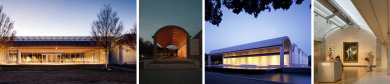
In these projects, light definitively stopped being a technical detail.
It became an integral part of architecture.
The Invisible Legacy That Continues Today
Today, when we enter a museum where light subtly guides us from one artwork to another, a restaurant where the atmosphere feels just right, or a building where architecture gains depth and rhythm, we are often seeing ideas that began with Richard Kelly.
The impact of his work was so significant that the Illuminating Engineering Society created the Richard Kelly Grant, a program that supports new generations of lighting designers.
But perhaps the most interesting thing is this:
Most people still have no idea who Richard Kelly was.
And in a way, that makes sense.
Because when lighting is well designed, it rarely calls attention to itself.
It simply transforms the way we see a space.
Light as a Language
Today, architects and designers understand that lighting can guide movement, highlight elements, create atmosphere and enhance architecture itself.
Light is no longer merely functional.
It has become an invisible language that shapes the way we experience spaces.
And much of this way of thinking began with Richard Kelly.
Perhaps that is why, whenever we enter a space and feel that everything simply works — without quite knowing why — there is a good chance that, in some way, his influence is still there.
At Tromilux, we believe exactly the same thing:
lighting is not just about illumination.
It is about enhancing architecture, guiding spaces and improving the way people experience them.
Because, as Richard Kelly showed almost a century ago, light can do far more than simply push back the darkness.